
Buyer guide · Handloom

Paithani or Patola, How to Tell and How to Choose

Patrons ask us to put these two beside each other almost every week, and once they are side by side the confusion ends quickly. A Paithani is woven, flower by flower, on the loom. A Patola is dyed into the yarn before a single thread goes on the loom. That one difference decides how each looks, how each ages and what each costs.

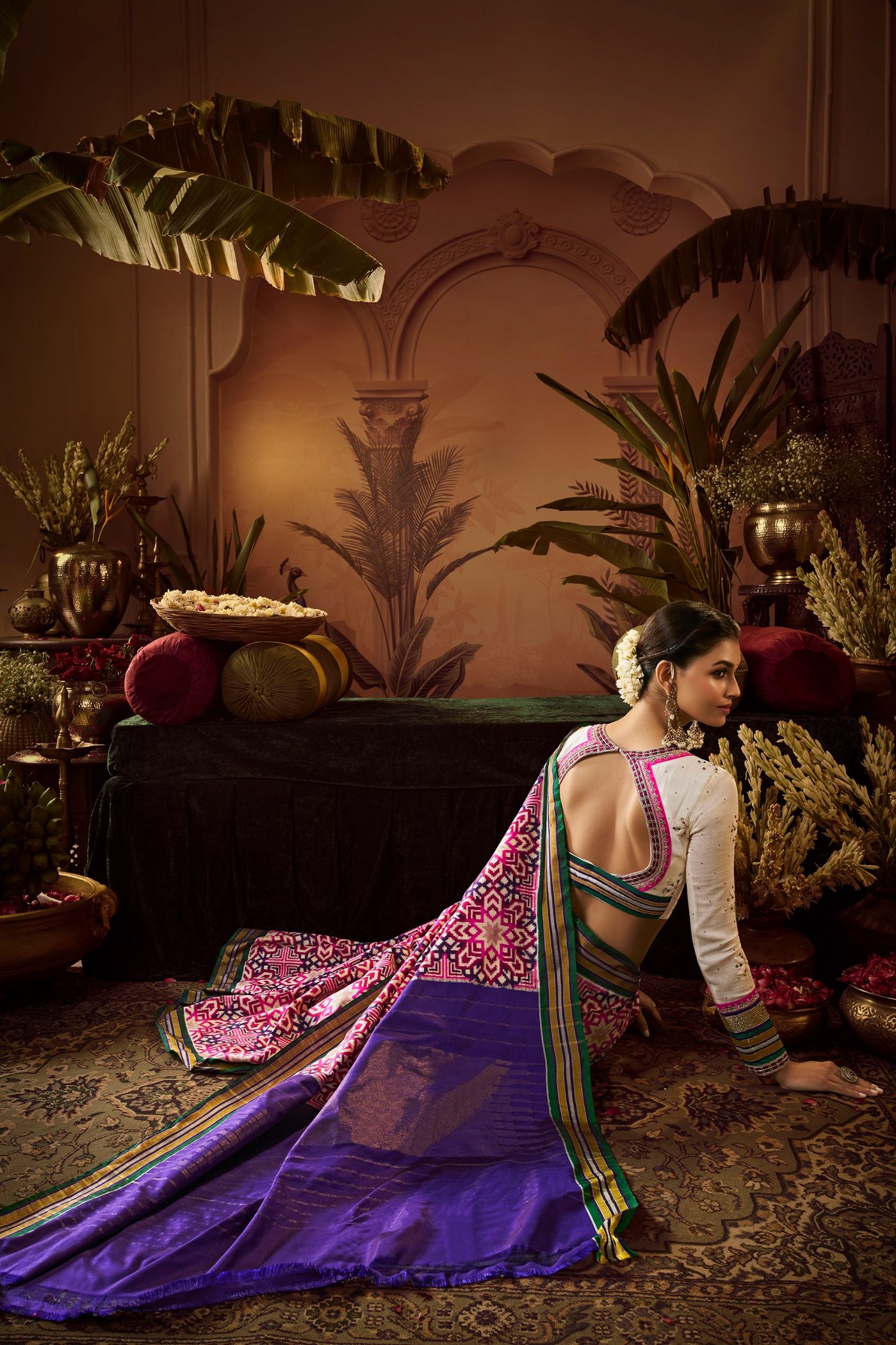
A violet Patola saree with a rose and gold pallu spread open on the floor of the Trisha Silks courtyard set

The Paithani, woven butta by butta

A Paithani comes from Paithan and Yeola in Maharashtra. The buttas and the pallu are woven with extra weft threads that the weaver interlocks by hand, which is why the reverse of a real Paithani is almost as neat as the front. The pallu carries peacocks, parrots, lotus and the muniya motif, and the border is done in the kadiyal technique so the colour changes cleanly at the edge without a seam.

The Patola, dyed before it is woven

A Patan Patola from Gujarat is double ikat. Every warp and weft thread is tied and resist dyed so that the pattern already exists in the yarn, and the weaver then aligns both directions on the loom until the motif meets exactly. That alignment is the entire craft. It is also why a genuine Patola reads identically on both faces and why the edges of each motif look very slightly feathered rather than knife sharp.

How to test each one in the shop

For a Paithani, turn the pallu over. Woven buttas show tidy interlocked threads on the reverse, printed or embroidered imitations show float threads or a stiff patch. For a Patola, look for the same pattern on both faces and a faint blur at every motif edge. Then spread it flat on the floor rather than holding it up, because a Patola only proves itself when you can follow the pattern from one end to the other.

Which function each suits

A Paithani is our answer for a reception, a Maharashtrian wedding, a naming ceremony or any evening where you want a woven gold pallu carrying the whole look. A Patola is our answer for a sangeet, a haldi morning, a festival lunch or a Gujarati and Marwari family function, because the colour is saturated all the way through and it reads brilliantly in daylight.

Price, and why a Patola costs what it does

A handloom Paithani at the atelier begins around thirty two thousand rupees and a bridal piece with a full brocade pallu reaches two lakh and above. A single ikat Rajkot Patola begins around eighteen thousand. A genuine Patan double ikat Patola starts near one lakh eighty thousand and goes far higher, because one saree can occupy two weavers for four to seven months. If a Patan Patola is offered to you for thirty thousand, it is a Rajkot single ikat, and that is worth knowing before you buy rather than after.

Paithani and Patola, side by side

PointPaithaniPatan Patola
OriginPaithan and Yeola, MaharashtraPatan, Gujarat
TechniqueWoven buttas with interlocked extra weft, kadiyal borderDouble ikat, yarn resist dyed before weaving
Reverse sideNeat interlocked threads, close to the frontIdentical to the front, both faces usable
Motif edgesCrisp, defined by the weaveVery slightly feathered, the ikat signature
Typical coloursIvory, black, peacock blue, magenta with goldMadder red, violet, green, mustard, ivory
Loom timeThree weeks to six monthsFour to seven months for double ikat
Best forReception, evening functions, heirloom giftingSangeet, haldi, festivals, daytime functions
Atelier range₹32,000 to ₹2 lakh and above₹18,000 single ikat, ₹1.8 lakh and above for Patan double ikat

We label single ikat and double ikat separately on every ticket. If a piece is a Rajkot Patola it is described as one, because the two are not the same thing and the price should never pretend they are.

Visit Us

Trisha Silks · Jubilee Hills

Plot No. 795, Road No. 36, Jubilee Hills, Hyderabad, Telangana 500033. Open daily 10:30 AM, 9:30 PM. Appointments preferred for bridal trousseau viewings.

Frequently asked

Questions from our Hyderabad patrons

What is the difference between a Paithani and a Patola saree?

A Paithani is woven, with each butta created on the loom using interlocked extra weft threads. A Patola is double ikat, where the yarn is tied and dyed before weaving so the pattern already exists in the thread. One is built at the loom, the other is built before it.

How can I tell if a Patola is genuine Patan double ikat?

Spread it flat and check that the pattern reads identically on both faces, then look closely at a motif edge for a faint feathering rather than a printed sharp line. Genuine Patan work also aligns the motif in both directions, so nothing drifts along the length.

Why is a Patan Patola so expensive?

Every warp and weft thread is tied, dyed and aligned by hand, and a single saree can occupy two weavers for four to seven months. The cost is loom time and skill, which is also why authentic Patan pieces rarely fall below ₹1.8 lakh.

Is a Paithani suitable for a bride?

Yes, particularly for the reception or for a Maharashtrian wedding, in ivory, black or peacock blue with a full brocade pallu. For a bride who wants the pallu to carry the whole look rather than the body, it is one of the strongest choices in the room.

Do you ship Paithani and Patola sarees abroad?

Yes, insured and fully documented to the US, UK, UAE, Singapore, Australia and Canada. We film the piece before packing so you can see the weave and the pallu in motion before it leaves Hyderabad.

Begin the conversation

Let us put both on the table for you.

We keep Paithani and Patola open side by side at the atelier because the difference stops being an argument once you can touch them. Visit Jubilee Hills or ask for a video viewing.

Read next

Guides for the Hyderabad bride