
Banarasi vs Kanjivaram, an Honest Comparison
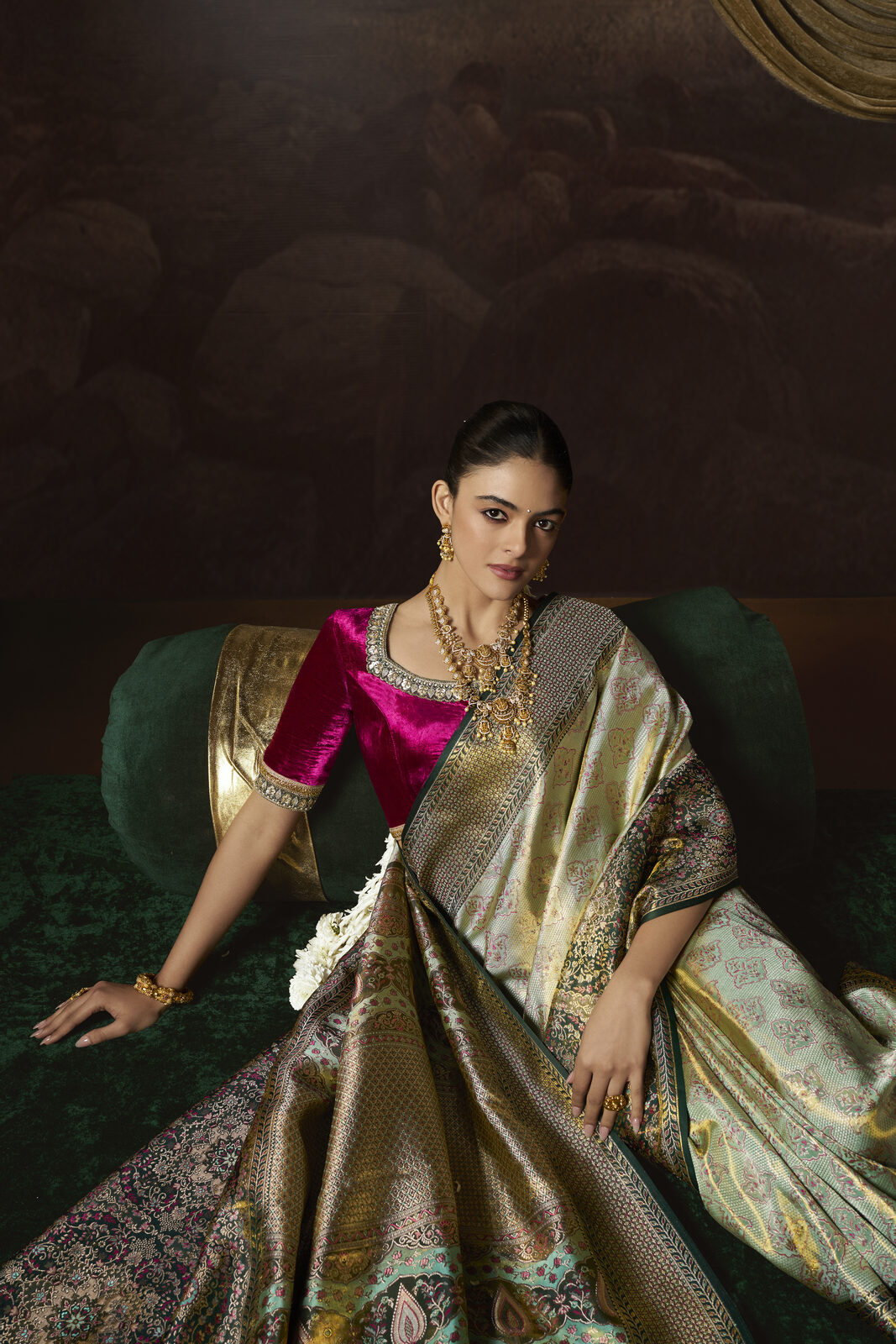
If you are buying your first serious silk saree, the choice almost always comes down to Banarasi or Kanjivaram. Both are pure silk, both carry real zari, both are made on a handloom by families that have been weaving for six or seven generations. They are not the same fabric and they do not serve the same wardrobe.
We stock both weaves direct from the loom and we sell roughly equal numbers each year. Patrons usually need one of each in a complete wardrobe. This guide is meant to settle the comparison so you can buy the right one first.
Where they come from
Kanjivaram is woven in Kanchipuram and the surrounding villages of Tamil Nadu. The technique is at least four hundred years old. The defining feature is the korvai border, where the body and the border of the saree are woven on three shuttles in two different colours and joined invisibly down the length.
Banarasi is woven in Varanasi and a cluster of villages around the city. The technique came in through the Mughal courts and has been refined for five centuries. The defining feature is the kadhua weave, where the motif is woven by hand one warp at a time, almost like embroidery on the loom.
How they feel in the hand
A pure Kanjivaram is heavy. A six yard piece often weighs between 800 grams and a kilo. The silk yarn is thicker, the zari is bridal weight, and the drape falls in firm structured pleats. It holds a shape on the body like very few other fabrics can.
A handloom Banarasi is lighter. The same six yards usually weighs 500 to 700 grams. The silk is finer, the zari is softer, and the saree drapes more fluidly. Pleats fall in softer cascades. It moves on the body in a way a Kanjivaram does not.
How they read in photographs
Kanjivaram photographs as gravity. The borders read sharp, the contrast colour pops, and the saree looks regal even in flat light. This is why it is the canonical bridal muhurtham saree.
Banarasi photographs as detail. The kadhua motifs catch light from every angle, the zari shimmers in low light, and the saree looks delicate and intricate up close. This is why it dominates receptions and engagements.
Which occasion suits which weave
For a bridal muhurtham, choose a Kanjivaram. For a bridal reception, either works, but a Banarasi reads dressier under hall lighting. For weddings you attend as a guest, a soft Banarasi or a lightweight Kanjivaram are both safe.
For a temple visit or a family lunch, a soft Kanjivaram or a Banarasi tissue is ideal. For a formal evening, a heavy Banarasi in jewel tones. For an everyday silk you wear to work or a kitty, a Mangalagiri or Chanderi will serve you better than either.
Price, plainly
A pure handloom Banarasi at Trisha Silks begins at around 35,000 rupees and reaches 3 lakh for a full kadhua bridal piece. A pure Kanjivaram begins at around 45,000 rupees and reaches 6 lakh for full bridal weight with pure zari.
The price difference between the two is mostly the silk weight and the zari content. A Banarasi uses less silk and lighter zari, so the price per piece is naturally a little lower. Neither is better value. They are different fabrics for different occasions.
If you can only buy one
Buy the one you have fewer of in your wardrobe. If you have inherited a Kanjivaram from your mother, buy a Banarasi. If you have a Banarasi already, buy a Kanjivaram. The two complete each other and most patrons end up owning both within a few years.
If you are buying your first serious silk and have no inheritance, a soft Kanjivaram in a wearable colour, navy, wine, mustard or emerald, is the most versatile starting point. You will get fifteen years of wear out of it across weddings, festivals and family functions.
See these weaves in person.
The Trisha Silks flagship at Jubilee Hills, Hyderabad welcomes private viewings. Patrons abroad, we host video viewings worldwide.
Frequently asked
What is the main difference between Banarasi and Kanjivaram?+
Kanjivaram is heavier, woven in Tamil Nadu with a korvai contrast border and thick silk yarn. Banarasi is lighter, woven in Varanasi with intricate kadhua motifs and finer silk. Kanjivaram drapes structured pleats, Banarasi drapes fluidly.
Which is better for a bridal saree, Banarasi or Kanjivaram?+
For a South Indian muhurtham, a pure Kanjivaram is the canonical bridal choice. For a reception or engagement, a Banarasi reads dressier under hall lighting. Many brides buy one of each for the wedding week.
Which is more expensive, Banarasi or Kanjivaram?+
A like for like pure handloom Kanjivaram is usually a little more expensive than an equivalent Banarasi because Kanjivaram uses heavier silk yarn and bridal weight zari. Top end pieces in both weaves can cross 3 to 6 lakh rupees.
Which weave is more comfortable to wear all day?+
Banarasi is lighter and drapes more fluidly, which makes it more comfortable for long evening functions where you are seated and walking around. Kanjivaram holds structure but is heavier and warmer to wear in summer.
Can I wear a Kanjivaram to a North Indian wedding?+
Yes. A pure Kanjivaram in a contemporary colour reads beautifully at a North Indian wedding and is now a familiar choice across regions. Pair it with polki or kundan jewellery to suit the setting.
From the Journal
Chanderi vs Maheshwari: How to Choose
Both come from Madhya Pradesh. One is sheer and ethereal, the other dense and reversible. Here is how to choose.
Organza, Tissue & Kora Silk: A Buyer's Guide
All three are light. All three are sheer. But only one drapes like water and only one holds its sculpture. Here is how to choose.