
The Organza Banarasi Renaissance
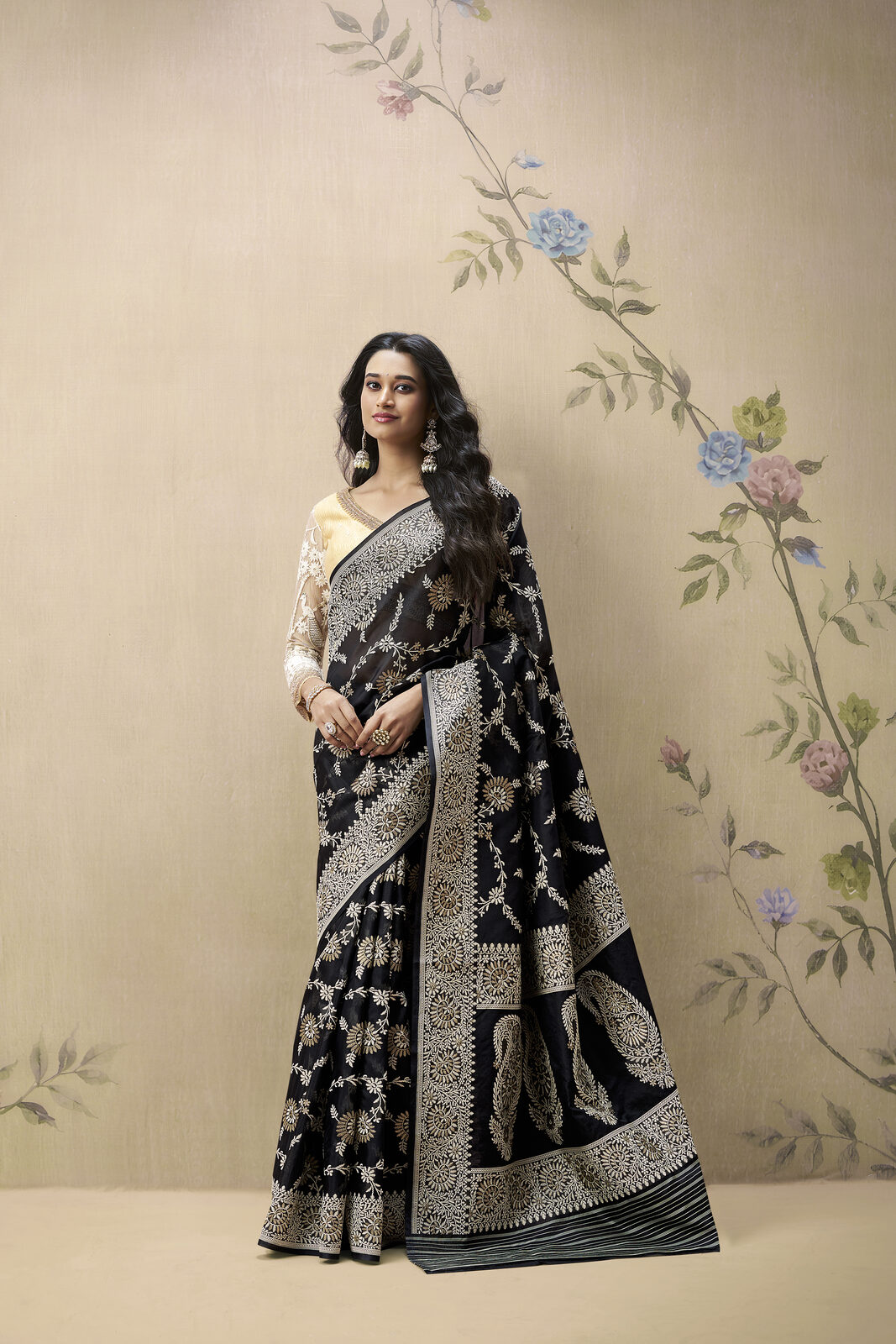
Five years ago, organza Banarasi was a niche curiosity for women who found the traditional kadhua too heavy. Today it is the most-requested saree in our archive, and the centrepiece of almost every modern Indian summer wedding from Udaipur to Jaipur to a London civil registry. The renaissance has a reason, and it is worth understanding.
Our organza Banarasi pieces are commissioned directly from the silk-organza specialist looms in Mubarakpur and Saraimohana. Each weighs between 200 and 360 grams and is signed on the reverse with the karigar's name.
What organza Banarasi actually is
Pure silk organza is mulberry silk yarn that has been highly twisted and tightly woven, producing a fabric that is sheer, crisp and weightless. When woven in Banaras with traditional Mughal jaal, jangla and shikargah motifs in real zari, you get a Banarasi saree that drapes like air and reads like history.
It is not georgette Banarasi (which is softer and slightly opaque), not Kora Banarasi (which is cotton-silk and matte), and emphatically not 'organza-look' synthetic polyester. Real organza burns to a fine grey ash and smells of singed hair; the synthetic melts.
Why it took over
Three reasons. One, climate, Indian and diaspora weddings increasingly happen in May, June, July and September, when a 1.1 kg kadhua is physically unwearable through a three-hour ceremony. Two, photography, organza catches light differently from heavier silks, photographing with a translucency that reads as both regal and modern. Three, age, a forty-year-old aunt and a twenty-six-year-old bride can both wear organza Banarasi and look entirely correct in it.
Occasion pairing, when organza Banarasi works (and when it does not)
Works: mehendi, sangeet, haldi, reception, engagement, cocktail, summer-wedding day-ceremony, courthouse registry, Eid, Diwali day-event, NRI cocktail evening. Does not work: a traditional Hindu muhurtham ceremony where the bride is expected to wear bridal weight, a December outdoor wedding in Delhi where the temperature drops, or a setting where the wind will lift it inappropriately. We are honest with brides who ask.
What to ask for in 2026
Specify pure silk organza (not georgette or polyester). Specify hand-woven zari (not embroidered post-weave). Specify weight (200 to 360g for a six-yard piece). Ask whether the border is kadhua-inset or run-through. Ask for the loom cluster and the karigar's name. A serious organza Banarasi from Trisha Silks ranges ₹35,000 to ₹1.8 lakh depending on zari weight and motif intricacy.
See these weaves in person.
The Trisha Silks flagship at Jubilee Hills, Hyderabad welcomes private viewings. Patrons abroad, we host video viewings worldwide.
Frequently asked
What is the difference between organza Banarasi and georgette Banarasi?+
Organza is highly twisted silk yarn woven crisp and transparent, it stands away from the body and catches light. Georgette is softer, slightly opaque, and falls closer to the body. Both are pure silk; organza is the more modern bridal choice.
Can I wear organza Banarasi as a bride?+
For the reception, sangeet, mehendi, registry or destination ceremony, yes, and beautifully. For a traditional Hindu muhurtham where bridal weight is expected, most families still prefer a kadhua Banarasi or pure Kanjivaram.
How much does a pure organza Banarasi cost?+
₹35,000 to ₹1.8 lakh at Trisha Silks, depending on zari weight (light tested zari vs heavy pure silver-and-gold), motif intricacy (light buti vs full kadhua jangla), and weave time on the loom.
From the Journal
Chanderi vs Maheshwari: How to Choose
Both come from Madhya Pradesh. One is sheer and ethereal, the other dense and reversible. Here is how to choose.
Organza, Tissue & Kora Silk: A Buyer's Guide
All three are light. All three are sheer. But only one drapes like water and only one holds its sculpture. Here is how to choose.