
How to Identify an Original Banarasi Saree
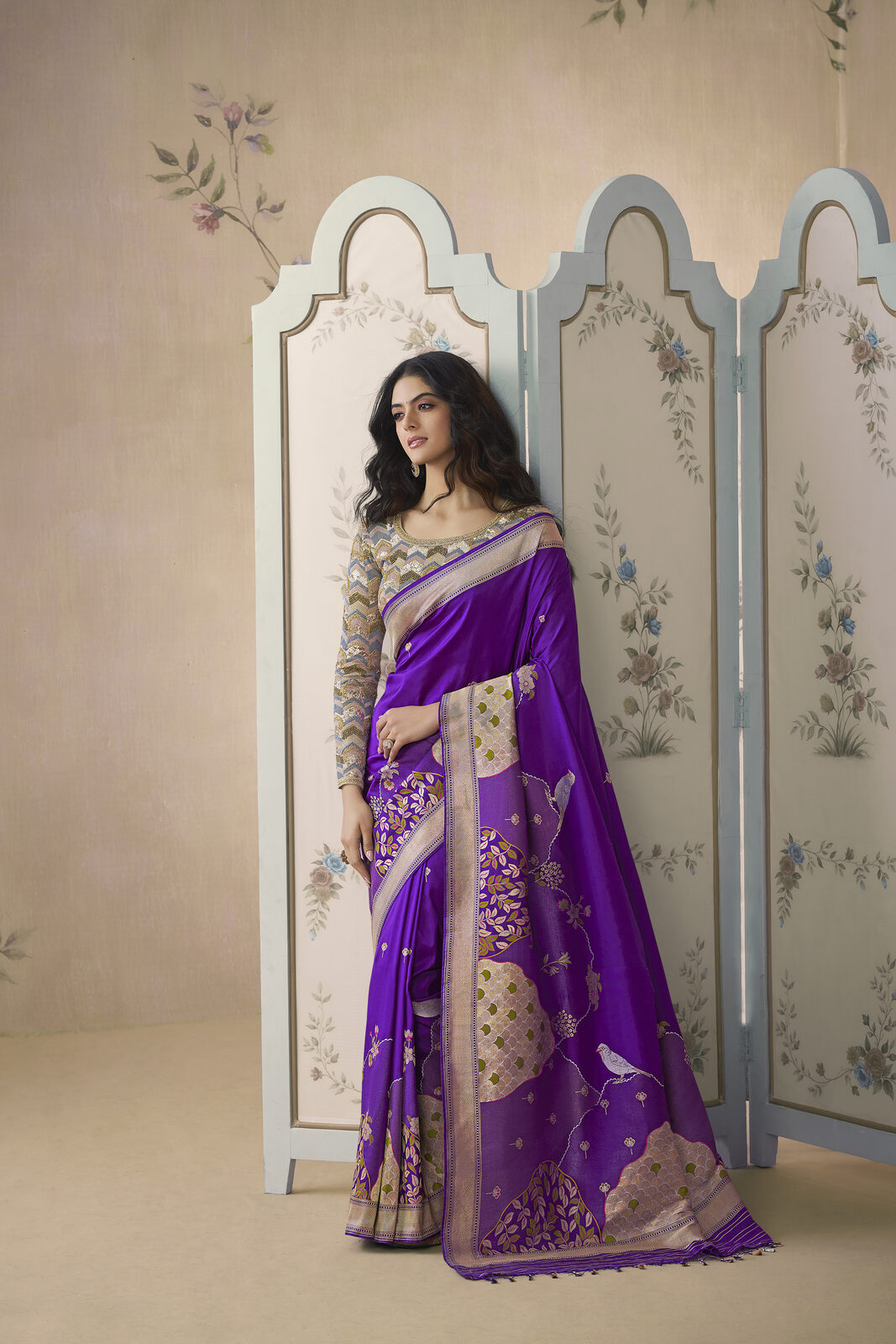
An original handloom Banarasi saree carries six tells you can spot without a loupe: float threads on the reverse, irregular zari, a soft hand, a slight asymmetry in the buti, the kadhua weave at the border, and the unmistakable scent of pure silk. Anything that looks too perfect, weighs too light, and shines too uniformly is almost certainly powerloom.
At Trisha Silks, every Banarasi is sourced directly from looms in Varanasi we have worked with for over a decade. We sign each piece with the karigar's name on the reverse, a small act of accountability the powerloom market cannot replicate.
1. Turn the saree over and read the reverse
The single most reliable test. On a true handloom Banarasi, the reverse of the pallu and the body shows long, untrimmed float threads, the leftover warp and weft the karigar leaves behind because cutting them would weaken the weave. Powerloom Banarasis are machine-finished; the reverse is clean, neat, and looks almost identical to the front.
Run your palm over the reverse. A handloom piece feels alive, slightly rough, with thread bumps. A powerloom piece feels flat and uniform.
2. Examine the zari, gold is never uniform
True Banarasi zari is a silk core wrapped in real gold or silver thread (or, more commonly today, a tested gold-coloured metallic). Under good light, real zari catches differently across the saree because each thread is wrapped by hand. It will not shimmer with the flat, almost plastic uniformity of synthetic powerloom zari.
A simple kitchen test: gently rub a small section. Real zari dulls but does not flake. Cheap metallised polyester zari will sometimes lift off in tiny flecks.
3. Look for the kadhua border
On a handwoven Banarasi, the border motifs are usually woven in the kadhua technique, each motif individually inset by hand, with separate weft threads. You will see tiny, almost invisible joins where each motif begins and ends. Powerloom borders run the weft thread continuously across the back, leaving a long unbroken float behind every motif.
4. The hand, silk should feel like silk
Pure Banarasi silk has a soft, slightly cool drape. It does not feel slippery (that is polyester) or stiff and papery (that is mercerised cotton blended in to fake the weight). When you crush a corner in your fist and release, true silk springs back with a gentle warmth, it has absorbed your hand's heat.
5. Asymmetry is the karigar's signature
A handloom Banarasi will always carry tiny imperfections, a buti placed a millimetre off, a colour shift in the dye, a slightly thicker thread somewhere in the pallu. These are not flaws. They are the karigar's signature. A saree with zero variation across nine yards has been made by a machine.
6. Ask for provenance
Any reputable house should be able to tell you which loom cluster the saree comes from (Mubarakpur, Madanpura, Pilikothi, Saraimohana, etc.), the name of the master weaver, and the time taken on the loom (a true Banarasi takes 15 days to 6 months). If a seller cannot answer these questions, walk away.
See these weaves in person.
The Trisha Silks flagship at Jubilee Hills, Hyderabad welcomes private viewings. Patrons abroad, we host video viewings worldwide.
Frequently asked
How can I tell a real Banarasi saree from a fake at home?+
Turn the saree over. A real handloom Banarasi has long, untrimmed float threads on the reverse and tiny inset joins at each motif (the kadhua technique). A powerloom fake has a clean reverse with continuous threads running across the back.
Is real Banarasi silk always heavy?+
Not necessarily. Modern handloom Banarasis come in lighter qualities, organza Banarasi, georgette Banarasi, kora Banarasi, that are deliberately featherweight. Weight alone is not proof of authenticity; the reverse-side test is more reliable.
How long does it take to weave one authentic Banarasi saree?+
Between 15 days for a simple butidaar Banarasi and up to 6 months for an intricate kadhua jangla or shikargah saree. The longer the weave, the higher the price, and the rarer the piece.
From the Journal
How to Identify a Pure Kanjivaram Silk Saree
A pure Kanjivaram has a contrast border woven separately and then joined, a tell no powerloom can fake. Here is the full test.
Patola Sarees Explained: Single vs Double Ikat
Single ikat or double ikat? The difference is six months on the loom and the only saree in the world that has no reverse side.