
Korvai Borders, How a Kanjivaram Is Truly Joined
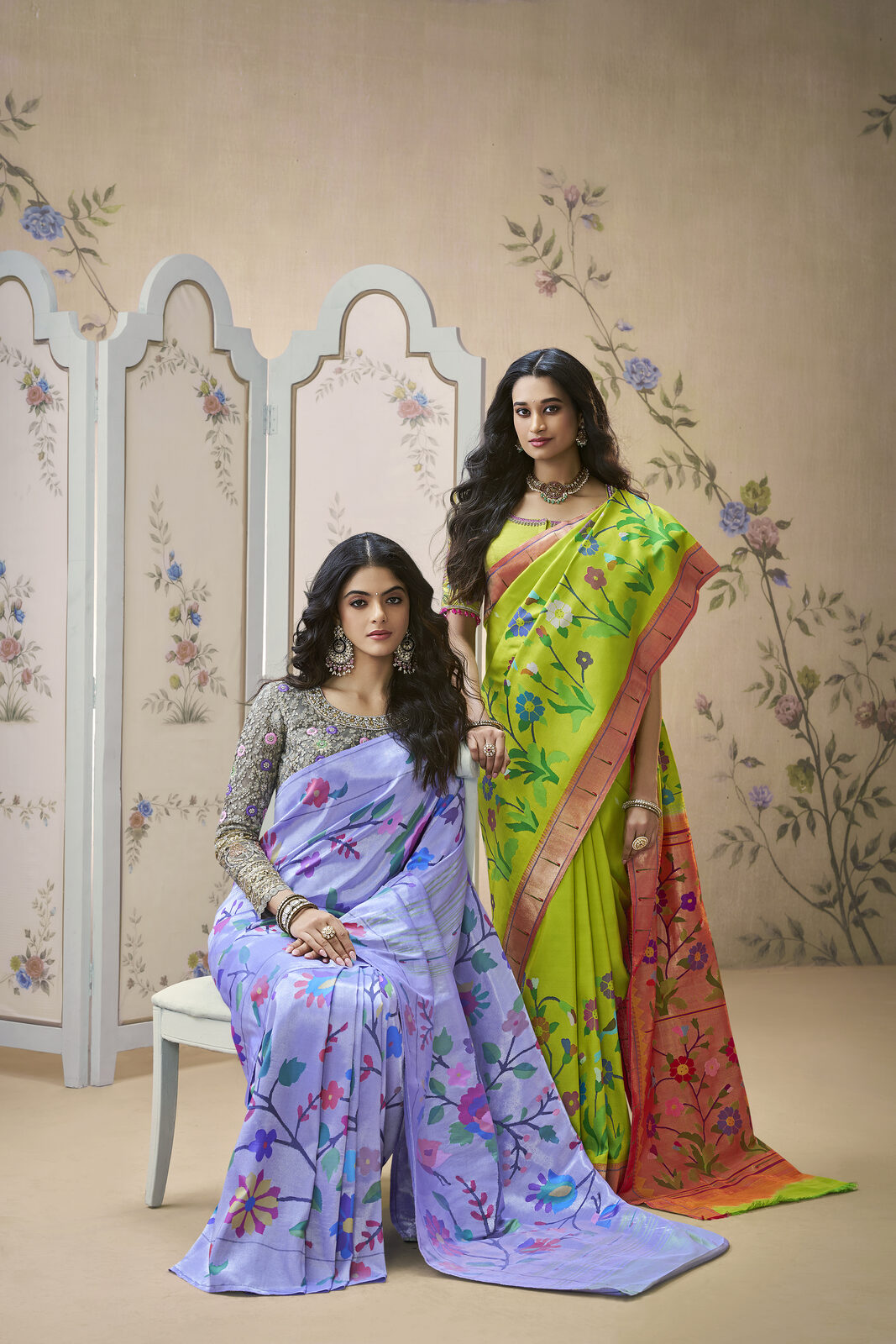
If you remember one test from this journal, let it be this: on a pure Kanjivaram, the contrast-coloured border is physically interlocked with the body of the saree through a technique called korvai. You can feel the join with your fingertip. You can see it under light. An imitation Kanjivaram skips korvai entirely, and that one omission is what makes it cost a quarter of the real thing.
Every Kanjivaram we carry passes a korvai inspection before it enters our archive. Pieces without a true korvai join, however well marketed, are sent back to the supplier.
What korvai is, mechanically
A traditional Kanjivaram is woven on a pit loom with three shuttles, not one. One shuttle carries the body warp and weft. A second shuttle carries the border warp in a contrasting colour. A third shuttle carries the pallu warp, often a third colour. Two karigars sit at the loom, one weaves the body, the other interlocks the border and pallu threads, by hand, across the entire length of the saree.
The interlock is the korvai. Where the body silk meets the border silk, the threads from each side loop into each other, knitting the two halves into one continuous fabric. It is the textile equivalent of a dovetail joint in cabinetry.
How to spot korvai in any shop
Open the saree flat at the border seam. Run your fingertip along the seam from selvedge to selvedge. On a real korvai, you will feel a faint, slightly raised ridge, that is the interlocked thread. Hold the seam to the light. On a real korvai, you can see tiny loops of one colour passing through tiny loops of the other.
On an imitation Kanjivaram (a 'soft silk' or 'art silk'), the border is simply woven in the same continuous weft as the body, meaning the same yarn runs all the way across, just dyed in two zones. There is no interlock. The seam looks neat from the front but flat from the back, with no ridge to feel.
Why korvai matters beyond authenticity
A korvai border is heavier, drapes in sculptural folds (because the two silks are slightly different tensions), and lasts generations because the interlock distributes stress evenly across the seam. An imitation border, woven continuously, develops a fault line at the seam after a decade and tears along it. Korvai is structural, not decorative.
Korvai and price, what to pay
A pure korvai Kanjivaram from a Kanchipuram cluster loom begins around ₹35,000 (light occasion piece) and reaches ₹3.5 to 5 lakh (fully bridal in pure silver-and-gold zari). A soft-silk Kanjivaram without korvai begins around ₹8,000. Both are useful pieces in their place, but they are not the same saree, and they should not cost the same.
See these weaves in person.
The Trisha Silks flagship at Jubilee Hills, Hyderabad welcomes private viewings. Patrons abroad, we host video viewings worldwide.
Frequently asked
What is the korvai border in a Kanjivaram saree?+
Korvai is a traditional three-shuttle weaving technique where the body of the Kanjivaram and its contrast-coloured border are woven on separate shuttles and physically interlocked at the seam, thread by thread. The result is a raised ridge along the border seam that you can feel with your fingertip.
Do all Kanjivarams have korvai borders?+
No. Only pure handloom Kanjivaram from the Kanchipuram cluster, traditionally woven on a three-shuttle pit loom, carry true korvai. Soft-silk and powerloom 'Kanjivaram' lookalikes skip korvai, which is precisely why they cost a fraction.
Does korvai make the saree heavier?+
Yes, slightly. A korvai border adds 50 to 120 grams to the saree's total weight and makes the border sit in sculptural folds. It is one of the reasons a real Kanjivaram drapes the way it does.
From the Journal
How to Identify an Original Banarasi Saree
Six tells the karigars use to separate a true handloom Banarasi from a powerloom copy, in plain language.
How to Identify a Pure Kanjivaram Silk Saree
A pure Kanjivaram has a contrast border woven separately and then joined, a tell no powerloom can fake. Here is the full test.